
Checking Criminal History in Des Moines
Begin with the event, not a broad name search. A report written by a Des Moines Police Department officer stays with DMPD. A booking record belongs to the Polk County Sheriff, while a criminal case belongs to the Iowa District Court for Polk County. The Iowa Department of Public Safety Division of Criminal Investigation, or DCI, maintains the statewide repository. None of these official sources replaces the others.
Use a report number or court case number whenever possible. Names alone can match more than one person. Dates, locations, an exact birth date where lawfully requested, and the arresting agency help keep a Des Moines record check tied to the correct event.
- Ask DMPD for the city incident or arrest record through its official public-record application.
- Check the Polk County Jail tools for a current inmate, recent booking, release, or a release within the prior 365 days.
- Search Iowa Courts Online, select Polk County, and open the matching case to read filed charges and the disposition.
- Contact the Polk Clerk of District Court for a public document, archived file, or certified copy that is not available online.
- Use the DCI Iowa record check when a releasable statewide Iowa history, rather than one Des Moines event, is needed.
Des Moines Arrest Record Form
The official DMPD Application for Public Records is the direct channel for a police-created record. It asks for contact details, the incident subject, date, time and location, and a case number when known. The requester describes the exact material and delivery method, then signs and dates the form.
DMPD lists a $5 arrest-record product and a $5 VISA letter. The research did not locate a complete fee list for other Des Moines police products, so a Des Moines requester should ask about cost before copies are made. The form also warns that state law or city ordinance can make some material confidential. A focused request for an identified record is more useful than asking the department to compile a new criminal history.
Police nonemergency service is available at 515-283-4811. That line can route a question, but the written form creates a clear description of the record sought. Give the city enough detail to find the existing file and state whether an electronic copy will work.
Des Moines Police Department Records
Des Moines Police holds reports made by its officers, including incident facts, arrest information and related records that can lawfully be released. The department is at 25 E. First Street in Des Moines. Polk County dispatch or jail involvement does not shift ownership of a DMPD narrative to the Sheriff. The arresting agency remains the first records custodian for the officer’s report.
An initial Des Moines report may state the time, place, involved people, officer observations and immediate facts. Supplemental investigative work can receive different treatment. Iowa Code chapter 22 allows access to public records, but section 22.7 protects categories that can include investigative material, victim or child details, medical data, intelligence information and personal identifiers. DMPD may redact a public copy or withhold a protected part while releasing what the law permits.
Ask for the report by case number if it is known. If it is not, provide the date range, exact Des Moines location and the subject’s name. A police record documents what officers recorded at that stage. It does not establish the final court result.
Four Des Moines Records Addresses
Des Moines concentrates several justice agencies downtown, but they are not one counter. DMPD keeps city police files. The Polk County Courthouse at 500 Mulberry Street houses the Clerk of Court in Room 212. The County Attorney works from the Polk County Justice Center at 222 Fifth Avenue. Criminal hearings may be set at the Criminal Courts Building at 110 Sixth Avenue. Going to the wrong building can add a needless stop.
Des Moines Police
25 E. First Street
Des Moines, IA
515-283-4811
Polk Clerk of Court
500 Mulberry Street, Room 212
Des Moines, IA 50309
515-561-5718
Polk County Jail
1985 NE 51st Place
Des Moines, IA 50313
515-323-5400
The online docket or hearing notice should be checked before travel because the event location controls. Courthouse screening and posted rules also apply. The Justice Center is a prosecution office, not the clerk’s certified-copy desk, and prosecutors do not maintain the court file.
Des Moines Arrests and Bookings
A person arrested by DMPD commonly enters Polk County Jail, where the Sheriff creates the custody record. The county’s jail and arrest information hub separates current inmates, bookings in the previous 24 hours, bookings on a prior date, recent releases, prior-date releases and a released-inmate search limited to the preceding 365 days. Choose the window that matches the timing.
The public booking fields may include a booking identifier, dates, arresting agency, charge label, bond and custody status. Federal-charge inmates are excluded from the county public lists. The Sheriff also warns that an arrest listing is not proof of guilt and does not give the disposition. For more detail on the county custody channels, use the Polk County arrest lookup.
A Des Moines booking allegation may differ from the count the County Attorney later files. The court can dismiss one count, amend another, or record a plea or trial result. Treat the DMPD report, jail booking and court docket as a sequence rather than three copies of one record.
Note: A missing name may reflect the search window, a release, a federal charge, spelling, or the fact that no Polk booking occurred.
Des Moines Report to Booking
The city-to-county handoff starts when a DMPD officer documents an incident and makes an arrest or serves court process. Jail staff then establish identity, inventory property, photograph and fingerprint the person, screen custody needs and enter the intake charges. The officer report remains at DMPD even though Polk County creates the new booking entry.
Fingerprinting is a key state link. DCI states that an arrest not fingerprinted and submitted will not create an Iowa criminal-history entry for that arrest. A prosecutor next decides which charge, if any, to file. The clerk enters that filing, hearings, orders, result and sentence in the unified state court system. Courts and agencies report dispositions back to DCI.
Local record path: DMPD incident report › Polk County booking › Iowa District Court filing › DCI disposition-linked history.
This timing explains why a new Des Moines arrest may appear in a jail list before a case appears online. It also explains why the words in an intake charge can differ from the later court count.
Municipal Court Records in Des Moines
Des Moines has no separate municipal criminal court or city docket search. Iowa uses one unified District Court. City ordinance cases, simple misdemeanors and state criminal prosecutions from Des Moines route to the Iowa District Court for Polk County. Magistrates, associate district judges and district judges handle different levels within that same court system.
Search the free Iowa Courts Online Electronic Docket Record Search by case number when possible. A name search should be narrowed to Polk County and checked against other identifiers. EDMS controls electronic documents and may require an account or case permission. The public docket is an index, not a fingerprint-verified history.
| Court Name | Iowa District Court for Polk County, Fifth Judicial District |
|---|---|
| Case Types Heard | City ordinance and simple misdemeanor matters, indictable misdemeanors, felonies and related criminal proceedings |
| Case Lookup Channel | Iowa Courts Online; EDMS for available documents; Clerk of Court for counter, archived and certified records |
| What the Docket Shows | Case number, type, filing date, parties, counts, events, hearings, disposition, sentence and available financial entries |
| Copies & Fees | Ask the Polk Clerk for current plain-copy and certification prices; no verified fee was located in the research |
No Des Moines Court Database
The phrase “municipal court” can send a Des Moines search in the wrong direction. The city enforces ordinances, but it does not operate a stand-alone criminal court. A DMPD case number also is not the same as an Iowa court case number. One points to the police file; the other identifies a filed judicial matter.
When no court result appears, first confirm that a prosecutor filed a case and that the search uses Polk County. A very recent booking can precede the filing. Search spelling variants, but do not assume a name match is the same person. If the docket identifies a document that is not open in EDMS, contact Room 212 and ask whether the document is public and what copy channel applies.
Read each count on the Des Moines criminal case. A Des Moines dismissal on one charge does not decide the status of another. “Disposition” means the outcome recorded for that count, such as dismissal, acquittal, conviction or another case resolution.
Where Des Moines Records Go
Des Moines records spread across systems as a matter moves forward. DMPD keeps the original city report. Polk County Jail keeps custody data. The Iowa District Court clerk records prosecution and outcome. DCI connects fingerprint-supported arrest cycles to reported dispositions and releases only what Iowa law allows.
Record flow: Des Moines Police Department › Polk County Courts › Iowa Department of Public Safety, Division of Criminal Investigation.
For a recent incident, the DMPD request is the best start. For present custody or a fresh booking, use the Sheriff. For filed counts and the final outcome, use the court. A $15 DCI name check covers releasable Iowa history and requires first name, last name and exact date of birth. DCI accepts online, mail, fax, email and in-person requests, but not phone requests. A signed release can affect what DCI may disclose.
The DCI public counter is at the Oran Pape State Office Building, 215 E. Seventh Street in Des Moines. Subject requests with government photo identification can be handled at the counter during its published service hours.
Des Moines DCI Record Counter
Des Moines residents have an unusual local option because the state repository counter is in the city. The DCI Criminal History Record Dissemination Unit is at the Oran Pape State Office Building. Its criminal-history line is 515-725-6066. The public counter is listed for immediate subject requests from 8:00 a.m. to 4:00 p.m. with government photo identification.
The state check is not a substitute for a DMPD file. It aggregates releasable Iowa criminal history, not the full police narrative, and it does not cover other states or federal cases. DCI charges $15 for each last name. Optional middle name, gender and Social Security number may help resolve identity, while first name, last name and exact date of birth are the required minimum identity fields.
A “no Iowa criminal history found” response can mean no record or no information lawfully releasable under the request conditions. It can also reflect missing fingerprints, an unreported result or confidential juvenile information. Compare a disputed Des Moines result with the court docket and the originating agency record before asking DCI to review a possible error.
Des Moines Record System Layers
As Iowa’s capital and the Polk County seat, Des Moines contains city, county, state and federal record holders within the same core. The official Census QuickFacts comparison supplies population context for Des Moines and the other leading Polk County cities. The agency overlap is convenient only when the reader knows which jurisdiction created the file. A state criminal prosecution appears in Iowa Courts Online. A federal prosecution from this region appears in PACER and the U.S. District Court for the Southern District of Iowa, not the state docket.
The Southern District of Iowa provides the official federal court context for Des Moines. This official source also supplied the image below.
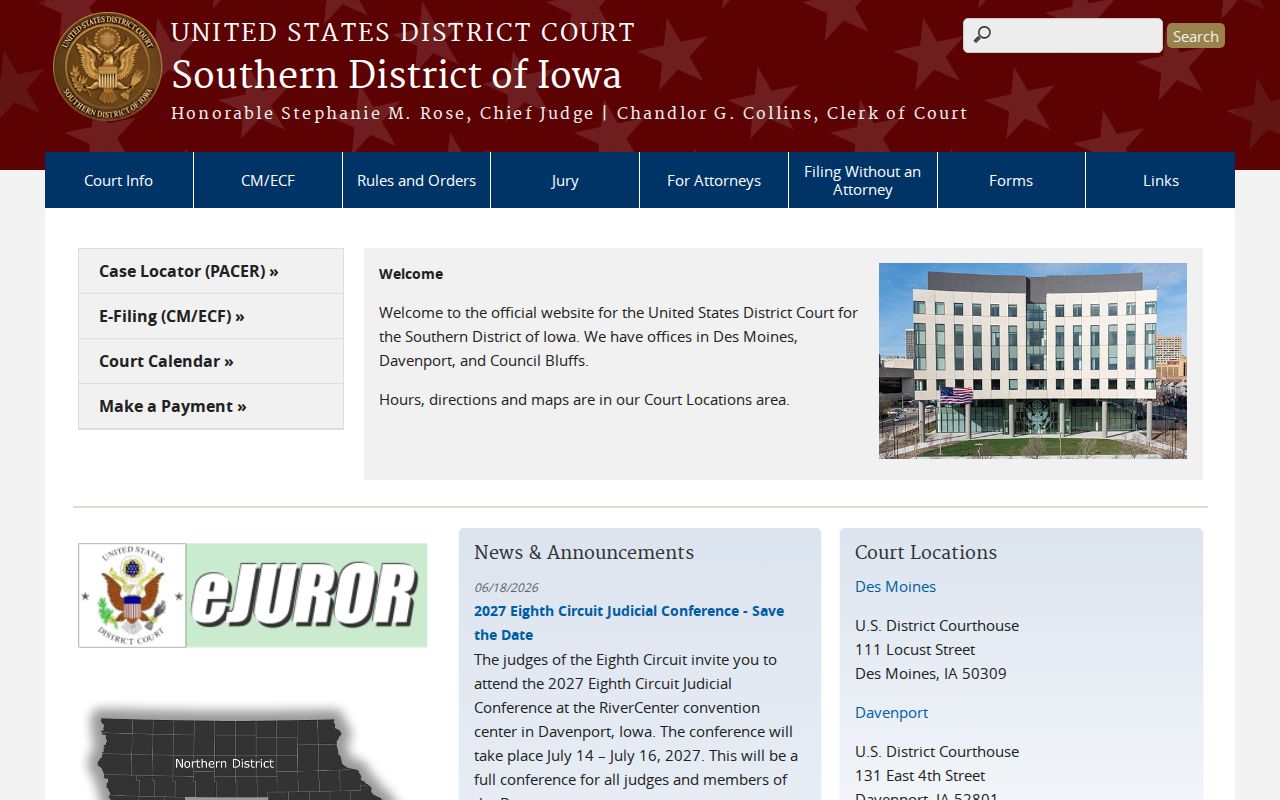
The federal layer matters only when the event was prosecuted in federal court. Federal custody uses the Bureau of Prisons Inmate Locator, while state prison custody uses Iowa DOC Find an Offender. Neither should be confused with the Polk County Jail list for local pretrial or short-term custody. A person reviewing a national fingerprint history uses the FBI's official Identity History Summary process, not a Des Moines police name search.
A city report can still be the first source even when a later prosecution changes jurisdiction. Follow the agency and case number, then use the correct docket rather than assuming every Des Moines charge belongs in one database.
Public Access Rules in Des Moines
Des Moines police access begins with the Iowa Open Records Law, but that law does not make every part of an investigative file public. A request should reasonably identify an existing record. The city may review, redact and withhold confidential portions, and it may charge lawful costs. Court records follow judicial access rules, while statewide criminal-history dissemination follows chapter 692.
Immediate facts and circumstances may remain public even when a DMPD investigative supplement is protected. If part of a request is withheld, narrow the request to a known report, date or public incident fact. The court clerk is the source for a prosecution record, not an alternate way to obtain a confidential police supplement.
Key Statutes:
Iowa Code §§22.2–22.3 grant access to public records and allow lawful supervision, copying and actual costs.
Iowa Code §22.7 lists confidential categories that can require withholding or redaction.
Iowa Code chapter 692 controls state criminal-history collection and dissemination.
Iowa Court Rule 16.201 et seq. governs access to EDMS and electronic court records.
Juvenile, sealed and expunged material may be absent from public Des Moines searches by design. Protected personal, medical, victim and intelligence data can also be removed from released copies.