
Polk County Criminal Court Cases
Every state criminal prosecution filed in Polk County goes to the Iowa District Court for Polk County, part of the Fifth Judicial District. Iowa does not split these matters between county and municipal trial courts. District judges hear felonies and other major matters. Associate district judges hear indictable misdemeanors and assigned cases, while magistrates handle simple misdemeanors, initial appearances, and preliminary hearings. A Des Moines ordinance case and an Ankeny simple misdemeanor still enter this unified court system.
The Polk County clerk creates and maintains the Polk County case file once a charge is filed. That file is distinct from a police incident report and a jail booking entry. Court case numbers also signal the type of matter. Common prefixes include FECR for a felony, AGCR for an aggravated misdemeanor, SRCR for a serious misdemeanor, and SMCR for a simple misdemeanor. The filed charge controls the class, even when the arrest record used a different label.
The Fifth Judicial District overview shows the district that serves Polk County.
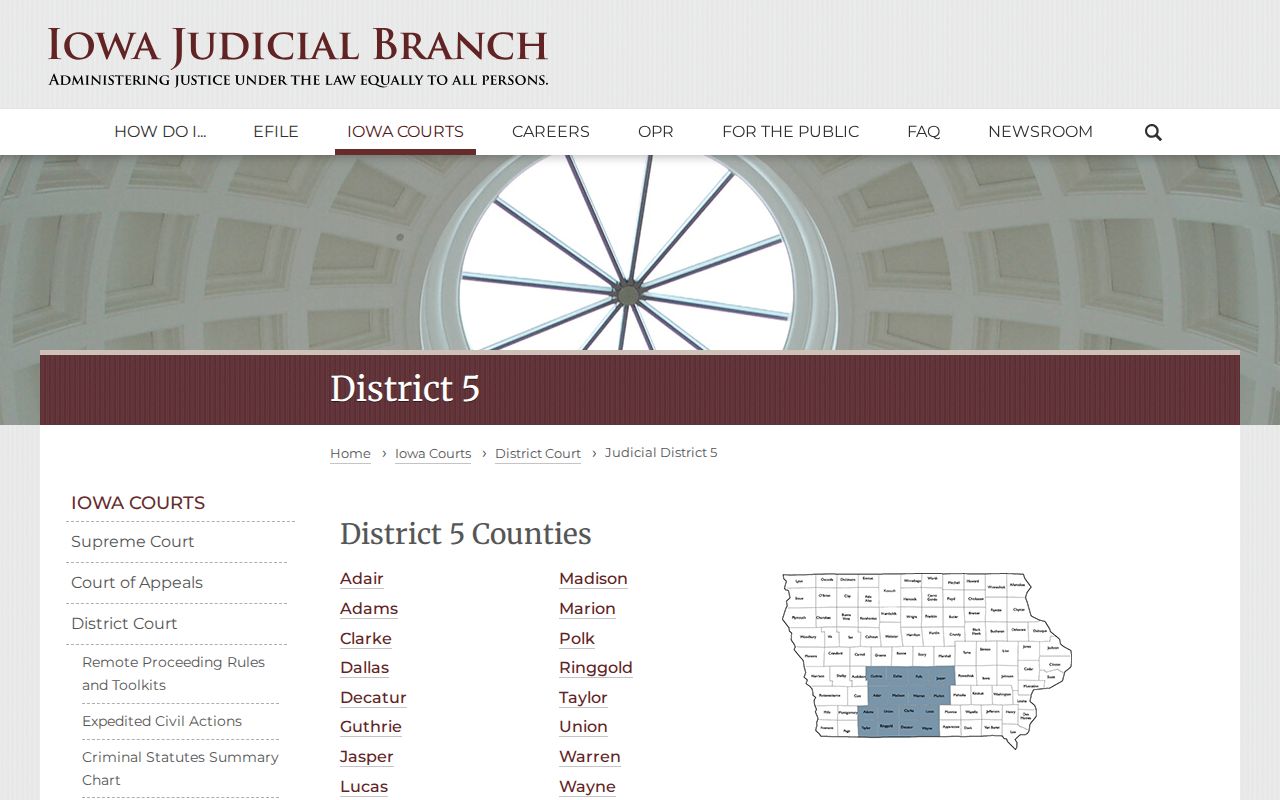
That district structure explains why all local criminal dockets use the same statewide court framework.
Polk County Court Buildings
Three downtown addresses can cause real confusion. The Polk County Courthouse at 500 Mulberry Street holds the Clerk of District Court in Room 212. The Criminal Courts Building is at 110 Sixth Avenue, and a hearing may be set there. The Polk County Justice Center at 222 Fifth Avenue houses the County Attorney and criminal prosecutors. It is not the clerk's records counter.
Check the Polk County online docket or hearing notice before going to court. For a public file, certified copy, archived material, or help finding a case, use the clerk at 500 Mulberry Street, Room 212. The clerk's phone is 515-561-5718, fax is 515-323-5250, and email is countyclerk.polk@iowacourts.gov. Security screening applies at judicial buildings. Bring the case number when possible and allow time to enter.
The official Polk County clerk page identifies the courthouse contact and service point.
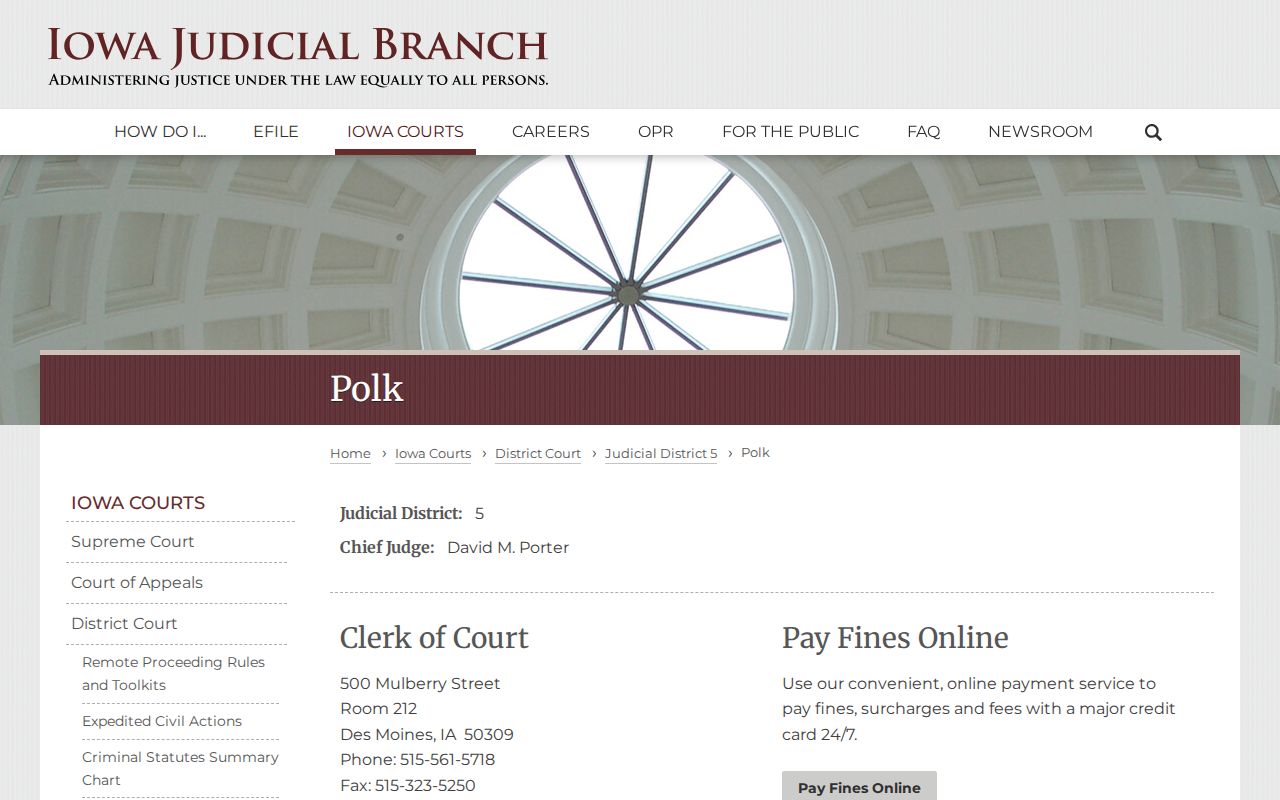
The clerk page is the best source to recheck contact details before requesting a court record.
Searching Polk County Case Records
Iowa Courts Online is the free Polk County starting point for a criminal docket. A case number is the strongest key. If it is unknown, search the party name, select Polk County, and compare the case type and filing details. Name spelling and aliases matter. Search results are an index, so the docket may identify a filing even when the document itself is not open online.
- Open Trial Court or Case Search in Iowa Courts Online.
- Enter the case number, or search the party name and narrow the county to Polk.
- Compare the case type, filing date, and party details before choosing a match.
- Open the docket and read each charge, event, and disposition separately.
- Ask the clerk for a public or certified copy when the needed document is not available online.
| Field Label | Type | Required | Notes |
|---|---|---|---|
| Trial Court / Case Search | Navigation | Yes | Choose the trial-court case search. |
| Case ID or Number | Text | No | Best identifier; prefixes can include FECR, AGCR, SRCR, and SMCR. |
| Party Name | Text | No | Use surname and given name; spelling and aliases affect results. |
| County | Dropdown | No | Select Polk for cases filed in Polk County. |
| Case Type or Date | Advanced | No | Advanced access adds case-type and scheduling searches. |
The official Iowa Courts Online search screen displays the controls used to locate Polk County criminal court cases.
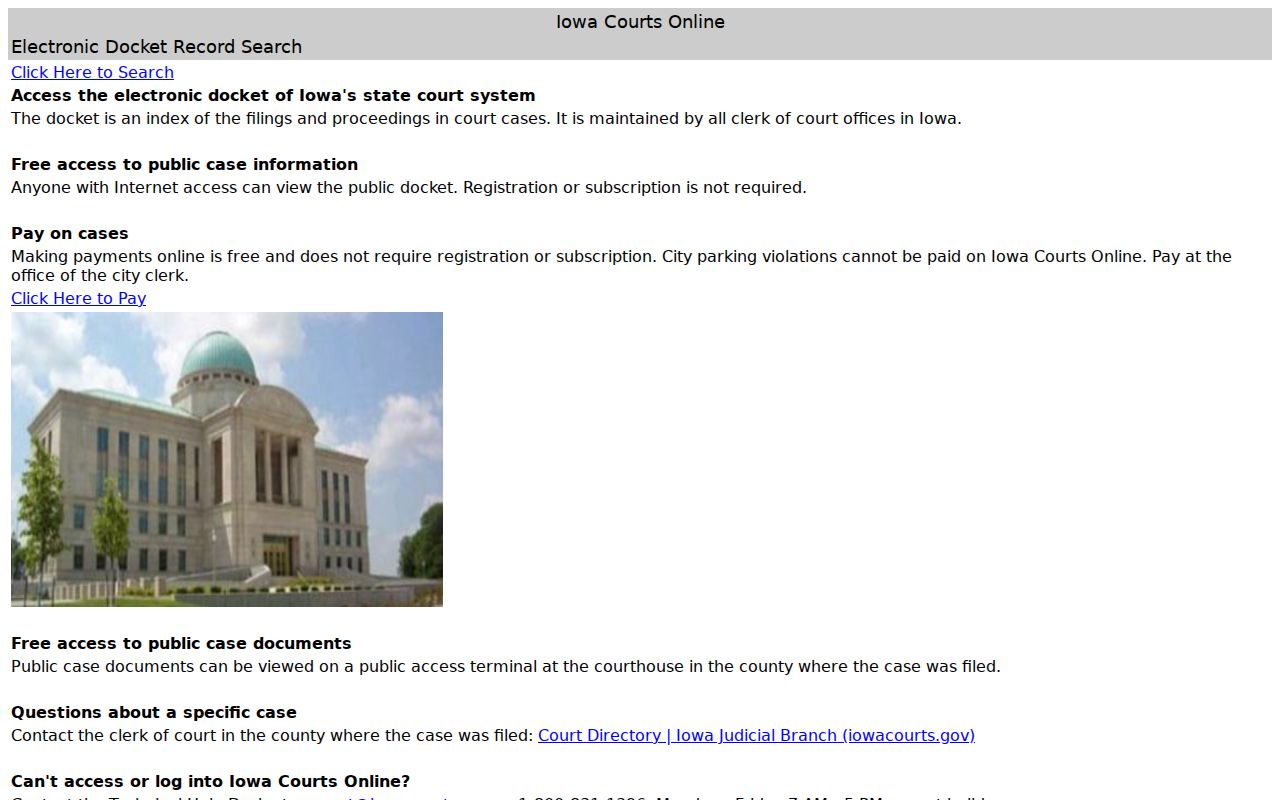
Start broad only when needed, then narrow to Polk County before treating a result as the right case.
Polk County Docket Access
For Polk County, the free public search provides core docket facts. Advanced Case Search is a registered, paid service that advertises more party data, complete financial information, exhibit lists, service returns, traffic data, and broader case-type or schedule queries. It does not turn a confidential document into a public one. The research did not establish a current subscription price, so confirm it on the live service.
The advanced login page distinguishes paid search features from the basic Polk County docket.
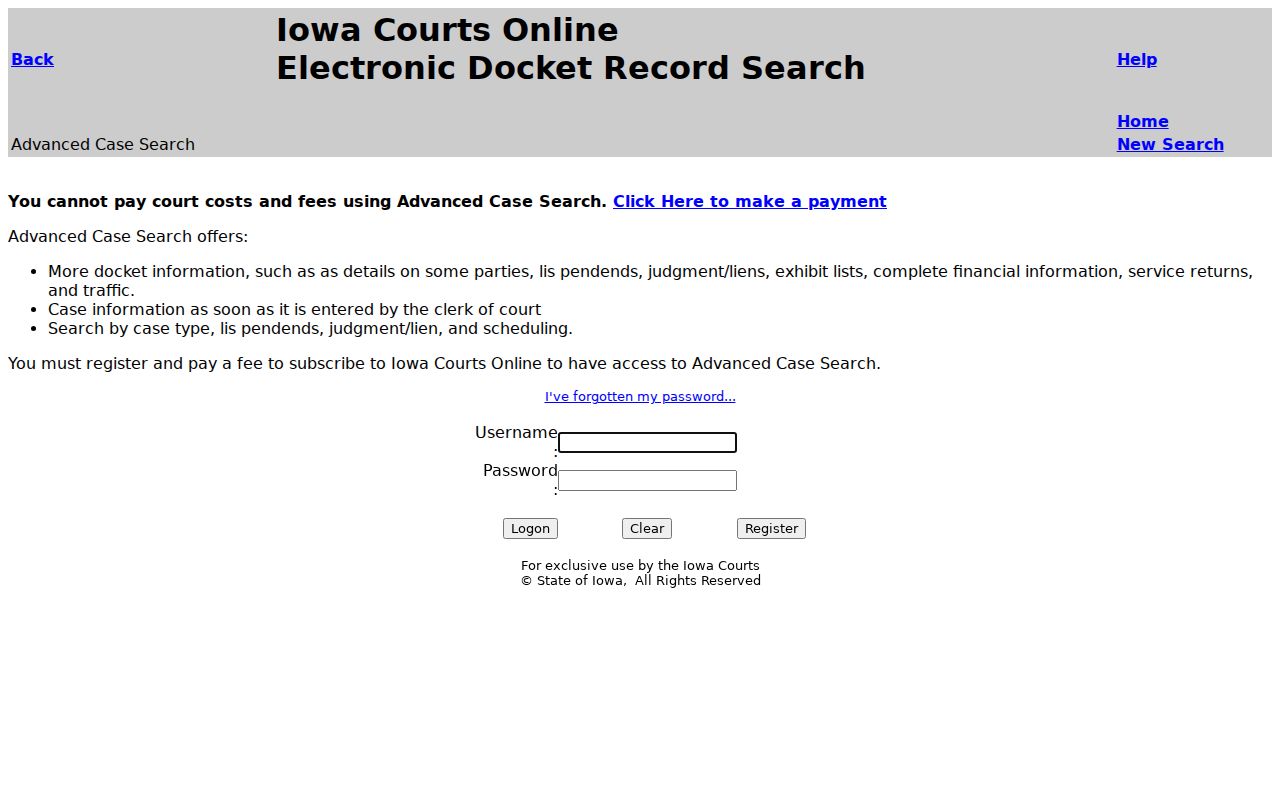
Use advanced access only when its extra fields solve a real search problem.
EDMS is Iowa's electronic filing and document system. It may require an account or case permission. A docket entry can therefore appear in Iowa Courts Online while the linked document remains unavailable to an unregistered user.
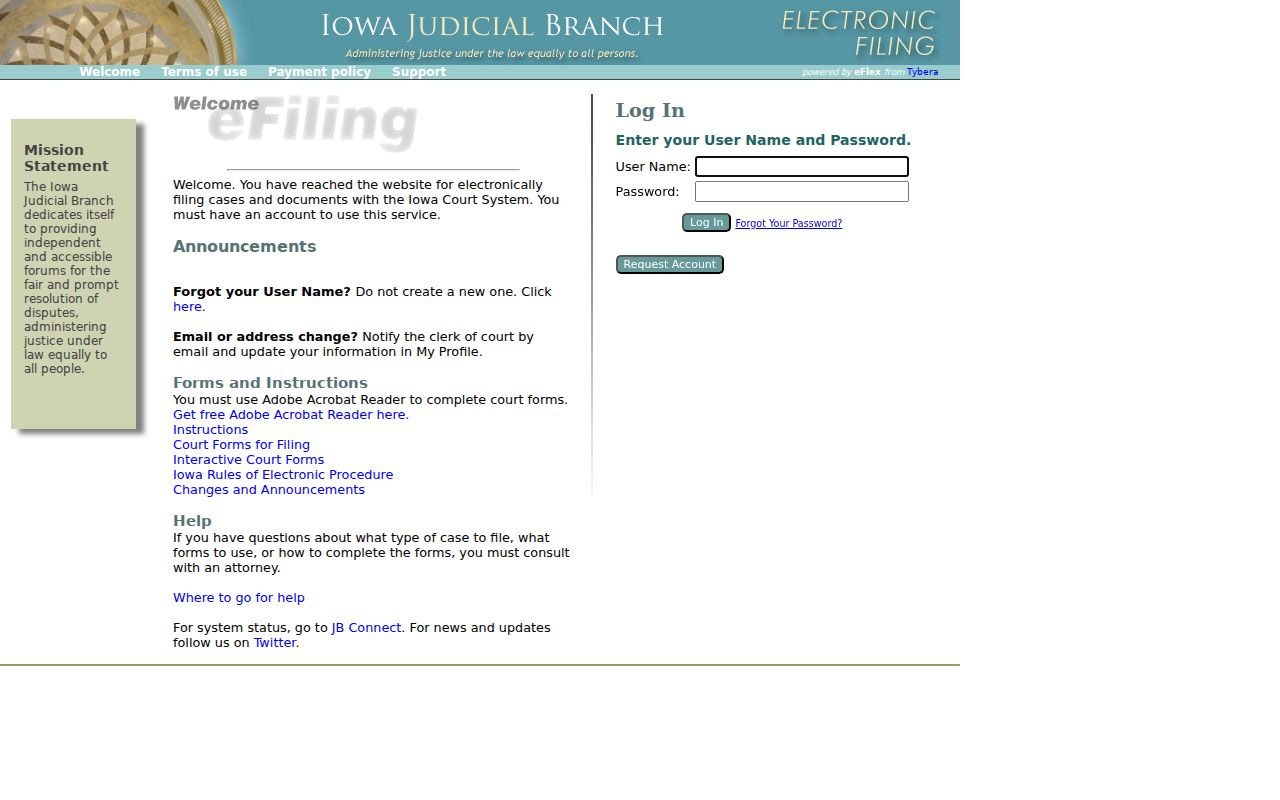
When EDMS does not expose a public filing, the Polk clerk can explain inspection and copy options.
Inside a Polk County Case File
A Polk County criminal case file records what prosecutors filed and what the court did. Read the header first, then move count by count. One charge may be dismissed while another ends in a plea or verdict. The overall status alone can hide that split result. A Polk County public view may also show counsel, financial obligations, hearing settings, and the judicial officer assigned to an event.
| Case Number & Court | Identifies the Polk County file, case type, filing date, and current status. |
|---|---|
| Charging Document | Shows the complaint, trial information, or indictment and each filed count. |
| Docket Entries | Lists appearances, motions, orders, pleas, warrants when docketed, and judgment events. |
| Hearing Dates | May show date, time, hearing type, location, and assigned judicial officer. |
| Disposition & Judgment | States the result for each count, such as dismissal, acquittal, plea, or conviction. |
| Sentence & Conditions | Records custody, probation, fines, costs, restitution, and other ordered terms as applicable. |
Protected identifiers, victim or minor data, confidential cases, and sealed documents do not become public merely because another part of the docket is open.
Polk County Criminal Case Codes
Case prefixes give a quick clue, not a full outcome. FECR means the court opened a felony case. AGCR and SRCR identify aggravated and serious misdemeanor cases, while SMCR identifies a simple misdemeanor. Iowa Code chapter 902 addresses felony sentences, and chapter 903 addresses misdemeanor sentences. The charge statute and count detail remain more important than the prefix because charges can be amended, dismissed, or resolved in different ways.
- Trial information
- The prosecutor's formal Iowa charging paper for an indictable offense.
- Arraignment
- The hearing at which the defendant enters a formal plea.
- Disposition
- The outcome of a charge, which must be read for each count.
- Deferred judgment
- A judgment withheld while the person completes court-ordered terms.
- Certified copy
- A clerk-authenticated copy used when an ordinary printout is not enough.
Note: A dismissed count does not establish the result of every other count in the same Polk County case.
How a Criminal Case Moves
A Polk County prosecution can begin after an arrest or a summons. An arrested person receives an initial appearance, where the court addresses probable cause, counsel, and release terms. For an indictable matter, the complaint is followed by a trial information or indictment. Arraignment, discovery, and pretrial motions come next. The case may end by dismissal, plea, or trial before judgment and sentence.
Case flow: Charges Filed › Arraignment › Pretrial › Plea or Trial › Disposition › Sentencing
A Polk County appeal creates a later layer. Always use the newest docket entries and judgment document when determining the current result. A booking allegation can change before filing, and a filed count can change again before disposition.
Polk County Charges After Arrest
The Polk County Attorney decides which state charges to file or dismiss. The office's Criminal Division works from the Justice Center at 222 Fifth Avenue, but the Clerk of District Court remains custodian of the filed case. That difference matters. A prosecutor's announcement may describe an accusation, while the clerk's later docket and judgment establish how the case ended.
After filing, the charge becomes part of the Polk County criminal court record unless a law or order restricts it. The defense may respond with motions, a plea, or a trial. A person seeking appointed counsel applies through the court. The County Attorney's official local FAQ addresses warrants, appointed counsel, seized property, and basic case process. A represented person should seek advice from defense counsel, not from the prosecutor.
Iowa provides official court forms for filings that use approved statewide forms.
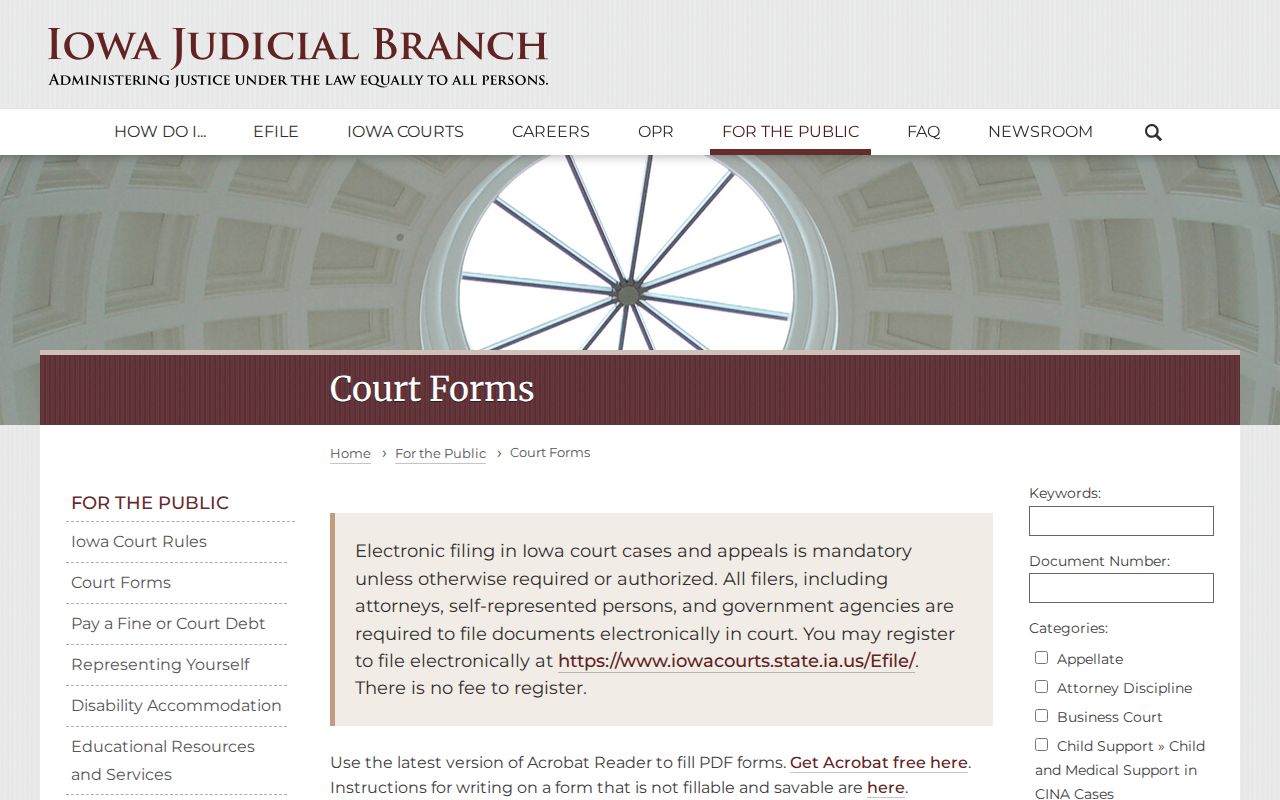
The forms library helps identify the proper document, while the clerk can address filing and public-copy procedures.
Case Record Access & Restrictions
Iowa Code chapter 22 gives access to public agency records, but court files also follow judicial access rules. Juvenile matters, sealed or expunged files, protected identifiers, victim and minor information, and confidential documents can be withheld or redacted. A blank search result can therefore mean more than one thing. The name may be wrong, the case may be filed elsewhere, data may still be processing, or public access may be restricted.
The Polk County online view is not always the whole public file. Contact Room 212 when a docket entry names a document that cannot be opened, an old file is not indexed as expected, or a certified outcome is required. Ask for the current copy and certification cost because the research found no official Polk fee schedule. The clerk can identify what is public but cannot provide legal advice.
Correcting Polk County Case Outcomes
If Iowa Courts Online shows the wrong disposition in a Polk County case, first compare the docket with the signed judgment and the result for each count. Then contact the Polk clerk with the case number and the specific entry in dispute. The source court must correct its own record. A later DCI criminal-history result may still carry the old outcome until the corrected disposition reaches the state repository.
For a DCI mismatch, call the Criminal History Record Dissemination Unit at 515-725-6066 and provide the disputed detail. DCI may use the supporting fingerprint record and may request fingerprints to resolve identity. A court correction and a repository correction are separate tasks. Neither Polk County Jail nor the arresting police agency can change a filed court judgment.
For broader context beyond the court file, the county's criminal history overview distinguishes court, jail, police, and DCI records.