
Checking Criminal History in Ankeny
Choose the first source by asking what happened. An Ankeny officer’s narrative belongs to the Ankeny Police Records Unit. An Ankeny custody entry created after transport belongs to Polk County Jail. Any filed criminal charge and disposition belongs to the Iowa District Court for Polk County. A DCI record check provides a separate Iowa-wide repository response.
The Ankeny online request can identify a specific Ankeny report, but it does not search court outcomes. Likewise, the court docket does not supply every police supplement. A good Ankeny record search follows the same incident across custodians and compares case numbers, dates and charge wording.
- Submit an Ankeny police record request with the report type, incident number, date, location and involved person when known.
- Contact the Records Unit at 515-289-5240 or visit the counter during published weekday report-copy hours if the online channel does not fit.
- Use the Polk County current-inmate, booking or release tool for recent custody created after an Ankeny arrest.
- Search Iowa Courts Online under Polk County, then ask the clerk for a public document or certified outcome that is not online.
- Request a $15 DCI Iowa check through its online, mail, fax, email or counter channels when statewide releasable history is needed.
Ankeny Incident Record Requests
The Ankeny Police Report Requests page identifies arrest, accident and officer reports, calls for service and statistics as Records Unit products. Its online form asks for requester contact information, report or incident type, case number, date, location, involved person, a description, desired delivery or media, and any upload or acknowledgment needed to submit.
Ankeny publishes a $5 fee for an incident report and $5 for a call-for-service record. The two products are not always the same. A call-for-service record can document a request for police response and basic dispatch facts, while the officer report records the incident investigated by the responding officer. Ask which one matches the needed Ankeny event before paying for both.
| Ankeny product | Published fee | Use |
|---|---|---|
| Incident report | $5 | Releasable police report or immediate incident facts |
| Call for service | $5 | Dispatch or service-call record |
| Black-and-white copy | 25¢ | Paper copy per page |
| Color copy | 50¢ | Color paper copy per page |
| DVD / USB | $5 / $10 | Digital media when the requested record requires it |
Ankeny staff cost may apply after the first 30 minutes. A narrow Ankeny request with an incident number reduces search time and makes it easier for the city to explain any estimate.
Ankeny Police Department Records
Ankeny Police headquarters is at 411 SW Ordnance Road, Ankeny, IA 50023. The Records Unit phone is 515-289-5240, and published report-copy hours are Monday through Friday from 8:30 a.m. to 4:30 p.m. Ankeny police officers create city incident and arrest reports even when another Polk County service handles dispatch or booking.
The official Ankeny Police Department facility page supplied this view of the local records destination.
The Ankeny building is the direct city counter for questions about Ankeny police copies and fingerprint-card service. It is not a court clerk or county jail records office.
An Ankeny requester should describe an existing record. Ankeny may release immediate incident facts while reviewing the remainder for protected content. The record can show what an officer reported at the time, but a police charge is an allegation. Search the court file for what prosecutors filed and how each count ended.
Ankeny Arrests and Bookings
Ankeny Police may transport an arrested person to Polk County Jail. The official county tools used after an Ankeny arrest separate current custody from recent booking and release data. Use Current Inmate Listing for someone believed to remain in custody. The previous-24-hour and prior-date booking views cover intake, while the release views and 365-day released search cover people no longer shown as current inmates.
An Ankeny-linked Polk booking can display a name, booking reference, dates, arresting agency, charge, bond and custody status. The county list excludes inmates with federal charges and does not report the case disposition. It also warns that an arrest is not proof of guilt. Ankeny’s own report may add releasable facts, but only the court file supplies the filed counts and final result.
New Ankeny activity may appear in the booking list before prosecutors file a court case. If a matching Polk County docket for Ankeny is not yet visible, check again or contact the clerk. Never turn the intake charge into a claim about guilt or assume that the wording will remain unchanged.
Ankeny Confidential Record Limits
Ankeny gives unusually clear notice of material that may not be released. The city identifies supplemental investigations, Social Security numbers, chapter 692 intelligence, victim or child identity, psychological and health information, and informant communications as confidential categories. That list helps explain why a copy can be shorter than the full police file.
An Ankeny requester who needs public incident facts should ask for those facts directly and identify the Ankeny case. If a supplemental report is withheld, a chapter 22 request does not erase the statutory protection. The city can review and redact responsive material, and it may explain the legal basis for withholding.
Ankeny police confidentiality also differs from court access. A later complaint, trial information, docket event or judgment can be public through Iowa Courts Online even when part of the underlying Ankeny investigation remains closed. The two access rules follow the office and record type, not a single label of “criminal record.”
Municipal Court Records in Ankeny
Ankeny does not operate a municipal criminal court database. Iowa has one unified District Court, so Ankeny ordinance matters, simple misdemeanors and more serious state charges go to the Iowa District Court for Polk County. Magistrates and associate or district judges work within that system rather than in a separate city court.
Search Iowa Courts Online and narrow the Ankeny case search to Polk County. A case number is the strongest key. A party-name search should be checked against the case type, filing date and other lawful identifiers. EDMS may provide documents based on account, permission and public-access rules, while the Polk Clerk supplies counter help, archived files and certified copies.
| Court Name | Iowa District Court for Polk County, Fifth Judicial District |
|---|---|
| Case Types Heard | Ankeny ordinance and simple misdemeanor cases, indictable misdemeanors, felonies and related proceedings |
| Case Lookup Channel | Iowa Courts Online, EDMS where available, and the Polk Clerk at 500 Mulberry Street, Room 212 |
| What the Docket Shows | Case number, status, parties, charge and statute, hearings, filings, disposition, sentence and available financial data |
| Copies & Fees | Ask the clerk for current inspection, plain-copy and certified-copy options; a verified amount was not found |
Ankeny Fingerprint Record Service
Ankeny Police offers fingerprint-card printing by appointment. The published fee is $15 for an Ankeny resident and $20 for a nonresident. Records staff can explain the appointment and identity requirements. This service captures prints on a card; it does not itself produce a DCI or FBI criminal-history result.
After Ankeny takes the prints, use the correct downstream channel. DCI maintains Iowa fingerprint-supported records and processes checks allowed by law. A person seeking an FBI Identity History Summary uses the FBI’s subject-request process with fingerprints and biographical information. The reason for the card and the receiving agency determine what form and submission method apply.
The resident and nonresident prices are city service fees, not charges for access to an Ankeny incident report. Do not combine them with the $5 report fee. Ask Ankeny Police what cards the requester must bring and confirm the appointment before arriving at SW Ordnance Road.
Where Ankeny Records Go
An Ankeny event can create several official records in order. Police create the incident or arrest report. Polk Jail creates the booking record when it receives the person. The Polk County Attorney decides what state charge to file, and the clerk records the case and outcome. DCI links fingerprint-supported arrest information with reported dispositions.
Record flow: Ankeny Police Department › Polk County Courts › Iowa Department of Public Safety, Division of Criminal Investigation.
The fastest Ankeny source depends on the stage. Ankeny Police is best for the original local report. The Polk booking list answers recent custody questions. Iowa Courts Online provides filed counts and dispositions. DCI offers a $15-per-last-name Iowa check with first name, last name and exact date of birth as required minimum fields.
DCI accepts requests online, by mail, fax, email and at its Des Moines counter. It does not take phone requests. A signed release affects disclosure of a discharged deferred judgment and older arrests without dispositions under Iowa rules.
Ankeny Record Types Compared
Ankeny uses several labels that sound alike but describe distinct Ankeny documents. A call for service begins with the request or dispatch activity. An incident report records the responding officer’s account. An arrest record concerns the officer’s custody action. A Polk booking record concerns jail intake. A court docket concerns prosecution.
- Call for service
- A record of a request for police response and related dispatch activity.
- Incident report
- The Ankeny officer’s account and immediate facts from the reported event.
- Booking record
- Polk County Jail’s custody entry after intake, which may show charge and bond data.
- Disposition
- The court’s recorded outcome for a charge, not the police or jail allegation.
The official Ankeny File a Report page distinguishes city reporting jurisdiction and local channels. It supplied the image below.
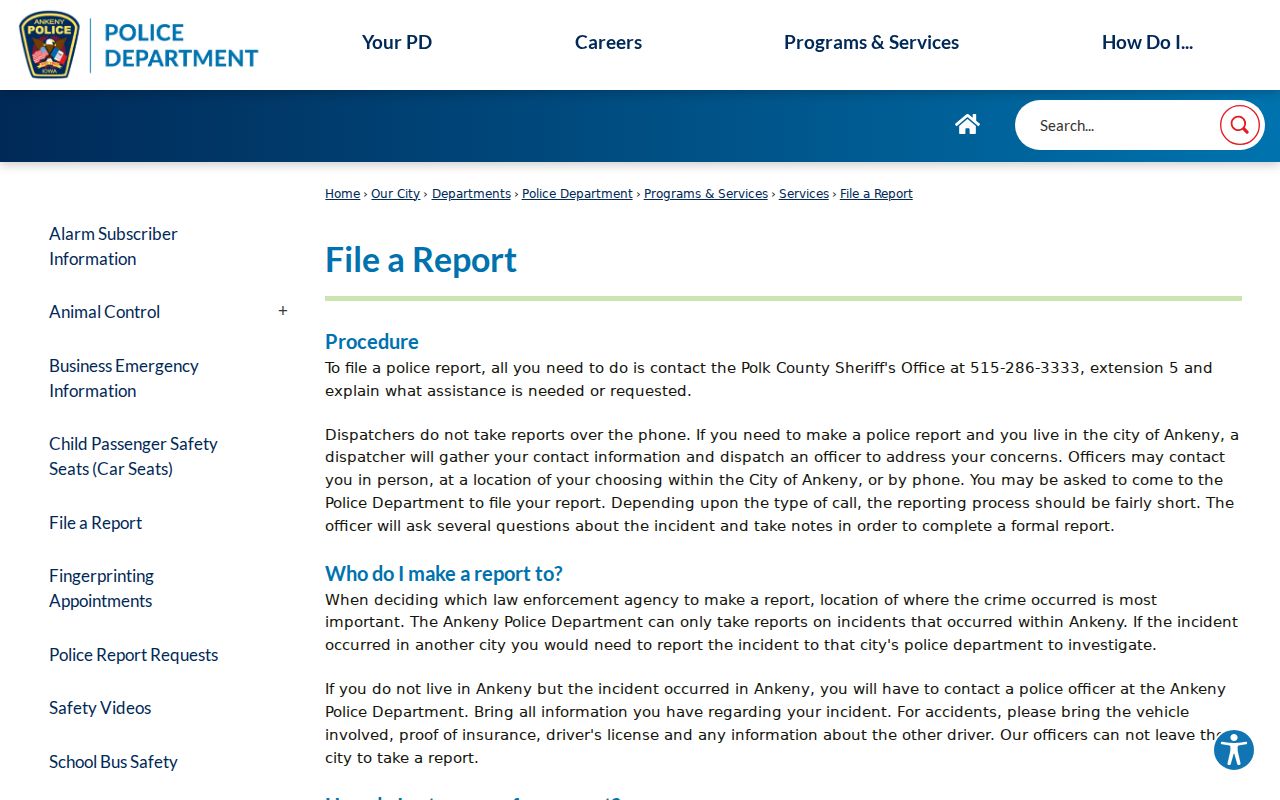
Filing an Ankeny report creates or adds information for police review. It is not the same act as requesting an existing public copy from the Records Unit.
Ankeny Records in a Growing City
Ankeny grew from a railroad and agricultural community into one of Iowa’s largest cities. Its justice records still use shared county and state systems. Ankeny growth did not create a separate municipal court or city jail search. That makes office identity more important as the number of city incidents and requests rises.
The local Records Unit provides a clear fee table, an online request and a weekday counter. Polk County supplies custody tools. The state Judicial Branch supplies the court docket. These services can feel fragmented, but each is tied to the agency’s role. Keep the Ankeny report number, Polk booking number and Iowa case number separate.
For a broad county explanation, the Polk County criminal history overview maps the Sheriff, clerk, DCI and corrections sources. At city level, begin with Ankeny Police whenever an Ankeny officer created the record.
Public Access Rules in Ankeny
The Iowa Open Records Law gives a right to examine and copy public records unless another law makes the material confidential. Ankeny can supervise access, charge lawful copying and actual costs, and redact protected information. An Ankeny request must identify an existing city record rather than require staff to create a new criminal-history report.
Court records for Ankeny follow Judicial Branch access rules. DCI dissemination follows chapter 692. Juvenile, sealed and expunged records can be restricted or absent from public channels. That is why an Ankeny police copy, an Iowa docket and a repository response can lawfully show different details.
Key Statutes:
Iowa Code §§22.2–22.3 cover public inspection, copying, supervision and lawful costs.
Iowa Code §22.7 protects listed confidential records and supports required redaction.
Iowa Code chapter 692 governs criminal-history collection and release through DCI.
Iowa Court Rule 16.201 et seq. controls electronic judicial-record access.
When an Ankeny response seems incomplete, identify the missing Ankeny item and ask the custodian whether it was not found, withheld or redacted. Then use the court or DCI only for the different record each one maintains.